

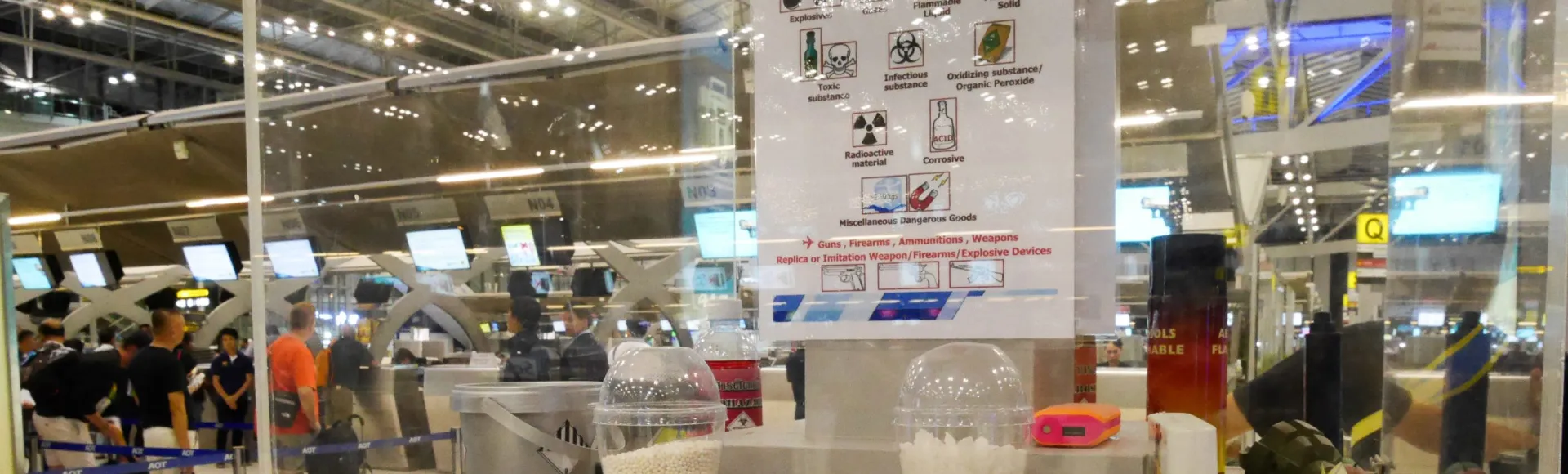
RESTRICTED GOODS
Find out more about restricted goods.
Some goods may be carried in your checked and/or carry-on baggage with certain restrictions based on their volume, quantity, weight, power or hazard.
In most cases, before check-in, a prior approval from all carriers involved in your flight itinerary must be obtained, if you plan to travel with any of the following goods:
Attaché cases, cash boxes, cash bags with installed alarm devices containing:
Lithium Cells or Batteries
Gases to expel dye or ink.
Ammunition.
Battery powered wheelchairs or mobility aids.
Mercury baromethere or thermometer
Carbon dioxide (dry ice)
Chemical agent monitoring equipment
Avalanche rescue backpack
Heat producing articles
Spare/loose batteries
Gas cartridges, small, non-flammable
Portable electronic devices
Portable medical electronic devices.
If any of the goods you plan to travel with falls in any of the above categories, you must request, from your travel agent or from any TAROM agency, an approval for the transportation of such goods. The request for approval must be done preferably at the time of booking but no later than 72 hours prior to your day of departure.
All goods that fall in the categories mentioned above shall be refused if you do not hold a prior approval for their transportation.
Also, any attempt to travel with forbidden goods or goods that require prior approval for their transportation shall be considered as endangerment of flight safety and treated accordingly.
GOODS RESTRICTED IN CHECKED OR HAND BAGGAGE
Lithium based batteries
Due to high susceptibility to catch fire or even explode as a result of high temperatures, impact or faulty construction, lithium based batteries require special precautions when transported by air.
Transport conditions for portable electronic devices (e.g. video cameras, drones, power tools, mobile phones, laptops, etc.), including medical devices (e.g. automated external defibrillators, nebulizers, portable oxygen concentrators, continuous positive airway pressure, etc.) and any spare batteries are based on:
Batteries with a rated capacity of up to 100 Wh do not require prior approval, but must be declared and inspected at check-in;
These batteries may be carried only in carry-on baggage;
A maximum of 2 Li-ion batteries per passenger is permitted (with a capacity of up to 100 Wh per battery);
the energy in watt-hour (Wh) for lithium-ion, lithium-polymer and similar batteries, and
the amount in grams (g) of lithium contained in lithium-metal, lithium-alloy and similar batteries.
More details HERE
Important:
If you arrive at the airport with more than 2 Li-ion batteries (under 100 Wh), the batteries will be refused for transport;
Li-ion batteries with a nominal capacity between 100 Wh and 160 Wh may be carried only with prior DGR approval and limited to a maximum of 2 per passenger;
Batteries with a capacity greater than 160 Wh are prohibited from transport;
For conditions of transport for battery driven wheelchairs or mobility aids, see below.
Wheelchairs or other mobility aids, powered by lithium batteries (used by passengers with reduced mobility)
The battery must not exceed 300 Wh, or for a device that is fitted with two batteries required for operation, each battery must not exceed 160 Wh.
A maximum of one spare battery not exceeding 300 Wh or two spares, each not exceeding 160 Wh, may be carried.
If your battery-powered wheelchair or mobility aid is specifically designed to allow its battery to be removed (e.g. collapsible), the battery must be removed and carried with you in the cabin, provided:
its terminals are insulated (e.g. taping over the exposed terminals) and
protected from damage by placing it in a protective pouch.
The removal of the battery must be performed before you arrive at the check-in desk.
Wheelchairs or other mobility aids, powered by non-spillable wet batteries (gel based)
If your wheelchair or mobility aid is specifically designed to allow its battery to be removed, you must:
Remove the battery and insulate its terminals (e.g. taping over the exposed terminals),
Place the battery in a strong, rigid container.
The removal of the battery must be performed before you arrive at the check-in desk.
Medical syringes
If you are transporting full or empty syringes for personal use we recommend obtaining a medical certificate. This will facilitate your passage at the airport security checks.
GOODS RESTRICTED IN CHECKED BAGGAGE ONLY
Toilet articles (e.g. perfumes) and aerosols may be carried in checked baggage only, provided the total net quantity you are transporting:
Does not exceed 2 kg / 4.4 lb or 2 liters / 67.628 fl. oz., and
The net quantity of each single article must not exceed 0.5 kg / 1 lb or 0.5 liters / 17 fl. oz.
Release valves on toilet articles and aerosols must be protected by a cap or other suitable means to prevent inadvertent release of the contents.
Thermometers
One small medical or clinical thermometer which contains mercury, for personal use, when transported in its protective case.
Sporting weapons and ammunition
For conditions of carriage regarding sporting weapons and ammunition, click here
Liquids
For conditions of carriage regarding liquids click here
GOODS RESTRICTED IN HAND BAGGAGE ONLY
Electronic cigarettes containing batteries (including e-cigars, e-pipes, other personal vaporizers containing batteries).
Spare batteries, powerbanks, including lithium metal or lithium ion cells or batteries.
Spare batteries (other than lithium batteries)
In your hand baggage only, you may carry a maximum of two spare batteries, provided that:
The voltage of each battery does not exceed 12 V and the power does not exceed 100 Wh, and
Each spare battery must be protected from short circuit by insulation of the battery terminals.